This past week and weekend has been my own personal hell. I had a test on Tuesday and a test earlier today, both of which required me to study. So, in spite of the fact that my word count on my WIP was trundling along nicely, I had to stop around Saturday and pretend to study because I felt way too guilty writing.
Over this dreadful past week I contemplated many things (like why am I a finance major? am I a masochist? or just stupid, and my teachers are too nice to tell me?). One of these things was, of course, about YA books.
I'm going to give it to you straight, gentle reader: I am an exceptionally picky person. I hate lots of people for lots of trivial things, and it only gets worse when it comes to fiction.
However, I do think that we are a little hard on our heroines from time to time.
There are a lot of demands on an author who's writing a teen girl these days. The girl has to be independent, but not unbelievable. She needs to be witty, but not so sassy she's annoying. Being too upbeat isn't realistic, but being a downer all the time isn't okay either. She needs to be completely whole without a man, but have many hot smooches.
Basically, you're screwed, authors.
The problem is that real girls do have flaws, and while people talk about needing a heroine to be flawed, there are certain flaws the YA community is awfully hesitant to accept: being whiny, being helpless in the face of lots of danger, and being dependent on a guy for validation. All three of which are EXTREMELY realistic flaws.
That's why it didn't bother me that the whole of Bella's self worth centered around whether or not Edward liked her. Because guess what, this is precisely what teenage - and let's face it, older - girls do. They fixate on a guy and obsess about him until their brain dribbles out their ears. While it isn't the most desirable state of being, it's not an unrealistic one and I didn't have a problem seeing it in a book.
No, Bella bothered me because she was boring.
So, authors of the world, here is my opinion: I don't care what flaws your character has, who she's codependent on, or what validation she needs. If she's interesting and 3-dimensional, I will read about her. If she's interesting and doesn't pay the slightest attention to guys, I will still read about her, but I'll be awfully skeptical. Because I don't care if you're a werewolf assassin from a future dystopian society; if you're 15 and have the giggles for that cute leprechaun glassblower, you are going to be 100% fixated on that.
Showing posts with label rants. Show all posts
Showing posts with label rants. Show all posts
Monday, September 20, 2010

Tuesday, March 23, 2010
My Thoughts on Paranormal Romance
Okay, this is a topic that's been coming up a lot recently. There have been already been a ton of great posts like this and this and this , so I'm not going to go over why this trend of psuedo-rapist love interests is a Very Bad Thing.
Instead, I'm going to talk about why I think these books have become so popular.
Paranormal books are (mostly) about escapism, for a lot of people. They whisk you away into magical adventures with magical creatures that you wish you could see and talk to.
Or do you? Most of these books (for instance the Wicked Lovely series by Melissa Marr) involve extremely dangerous creatures who hurl the main characters into life-threatening situations. Often friends or family members die, or at least are put in extreme situations. The main character has to grow up fast and make hard choices.
Do you really truly want to live in that world? Probably not. And yet we gobble up books like Twilight where the main character has her uterus ripped open by someone's teeth.
I think that the romances in paranormal books operate on this same principle. It has to be more extreme than real life. If someone were to hop into our bedroom at night and be like "Oh hai there how ya doin", we would be mightily freaked out. If a guy sexually assaults us, trust me, we will no longer find him attractive. Ever. Real life sexual assault is horrifying and frightening and demeaning.
But in books, this romantic intensity operates on the same principles of all the rape books that were so popular in the 50's and back. Girls like the idea of a boy being absolutely overcome with need for them, to the point where the girl can keep turning him down and he'll come back. In real life this doesn't happen because if we like someone, when they ask us out we go "YES PLEASE AND THANK YOU SIR". There's no chance for a guy to go to extremes chasing us. Books like Twilight and Hush, Hush let us live the fantasy without ever having to be in danger or discomfort.
Instead, I'm going to talk about why I think these books have become so popular.
Paranormal books are (mostly) about escapism, for a lot of people. They whisk you away into magical adventures with magical creatures that you wish you could see and talk to.
Or do you? Most of these books (for instance the Wicked Lovely series by Melissa Marr) involve extremely dangerous creatures who hurl the main characters into life-threatening situations. Often friends or family members die, or at least are put in extreme situations. The main character has to grow up fast and make hard choices.
Do you really truly want to live in that world? Probably not. And yet we gobble up books like Twilight where the main character has her uterus ripped open by someone's teeth.
I think that the romances in paranormal books operate on this same principle. It has to be more extreme than real life. If someone were to hop into our bedroom at night and be like "Oh hai there how ya doin", we would be mightily freaked out. If a guy sexually assaults us, trust me, we will no longer find him attractive. Ever. Real life sexual assault is horrifying and frightening and demeaning.
But in books, this romantic intensity operates on the same principles of all the rape books that were so popular in the 50's and back. Girls like the idea of a boy being absolutely overcome with need for them, to the point where the girl can keep turning him down and he'll come back. In real life this doesn't happen because if we like someone, when they ask us out we go "YES PLEASE AND THANK YOU SIR". There's no chance for a guy to go to extremes chasing us. Books like Twilight and Hush, Hush let us live the fantasy without ever having to be in danger or discomfort.
Wednesday, March 3, 2010
Race and Writing
Okay, I've tried to avoid this topic for as long as possible, but the fact is that there isn't anything to be gained by avoiding it. (There are possibly many people to offend, but... I'll just hope that this is taken in the spirit it's meant.) Everybody knows not to judge by skin color (if they don't they're a hopeless case and I vote for the "eject" button), so I'm going to talk instead about something racially oriented that bothers me.

I feel like a lot of so-called "progress" is really holding us back. For instance, the African American Interest section in all bookstores. Basically what that says is, "If you're black this is where you belong, because you won't be interested in anything that's not about black people, written by black people." It's so limiting. What's next - bookstores divided not into science fiction, romance, and non-fiction, but instead into Chinese, Korean, and Japanese?
I truly believe that the color of your skin means nothing. But I don't want to act like culture is meaningless - If you send an African American from New York and a white person from Louisiana to Africa, who are they going to have more in common with? The fellow American, of course. Backgrounds and cultural norms do mean something, but not the color of our skin.
And those backgrounds and cultures... what do they mean if we can't learn from each other? If this wall of "yours" and "mine" is up, how will anybody understand each other? You can claim that these segregations are to try to cater to the unique needs of African Americans, but that makes about as much sense as a line of books for "Nordic Descent". I personally have on quite a few occasions bought books targeted for African Americans, and let me tell you - people give you funny looks, black or white. I don't feel like I should have to explain myself for enjoying the work of an African American author. Whether intentional or not, these divisions throw up more barriers that need to be torn down.

If we're going to make divides, it would make more sense to me if books were split up in "lower socio-economic class", "middle socio-economic class", etc. After all, a black person from the Bronx is going to have a hell of a lot more in common with a white person from Harlem than with a black person from Georgetown, VA.
Pride in your culture is great, but when it comes down to it: it's not where you're from, it's where you're going.
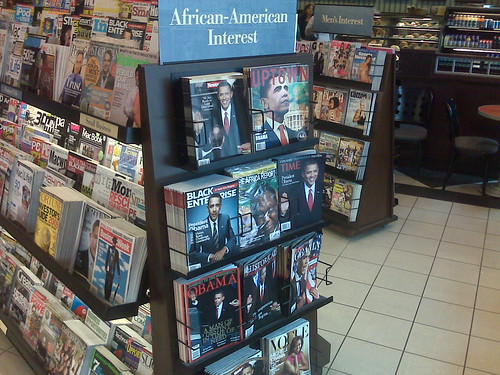
I feel like a lot of so-called "progress" is really holding us back. For instance, the African American Interest section in all bookstores. Basically what that says is, "If you're black this is where you belong, because you won't be interested in anything that's not about black people, written by black people." It's so limiting. What's next - bookstores divided not into science fiction, romance, and non-fiction, but instead into Chinese, Korean, and Japanese?
I truly believe that the color of your skin means nothing. But I don't want to act like culture is meaningless - If you send an African American from New York and a white person from Louisiana to Africa, who are they going to have more in common with? The fellow American, of course. Backgrounds and cultural norms do mean something, but not the color of our skin.
And those backgrounds and cultures... what do they mean if we can't learn from each other? If this wall of "yours" and "mine" is up, how will anybody understand each other? You can claim that these segregations are to try to cater to the unique needs of African Americans, but that makes about as much sense as a line of books for "Nordic Descent". I personally have on quite a few occasions bought books targeted for African Americans, and let me tell you - people give you funny looks, black or white. I don't feel like I should have to explain myself for enjoying the work of an African American author. Whether intentional or not, these divisions throw up more barriers that need to be torn down.

If we're going to make divides, it would make more sense to me if books were split up in "lower socio-economic class", "middle socio-economic class", etc. After all, a black person from the Bronx is going to have a hell of a lot more in common with a white person from Harlem than with a black person from Georgetown, VA.
Pride in your culture is great, but when it comes down to it: it's not where you're from, it's where you're going.
Tuesday, January 26, 2010
Do You Get It?
Instead of Teaser Tuesday, I decided to ramble on a little bit about a topic that's rather near and dear to my heart: "getting" books from different eras.
Brilliant books like Robert Heinlein's Citizen of the Galaxy (or simply fun ones like the Malory Towers series by Enid Blyton) are falling by the wayside in favor of ones whose pop culture references and language resonate with the people of today. Now, I'm not saying this is anything new, or nothing would ever get written, but I have to say that it kills my heart a little bit when the language in something written as recently as the 70s will cause my friends to say, "No thanks."
I think that some people have the impression that just because a book was written 20 or 100 years ago, the authors lacked humor, and any book they read will be drier than a History Channel documentary on watches. Not so! A great example of this is my current read, the Sherlock Holmes novels, which have lines like: "...the conduct complained of was that he had drifted into the habit of winding up every meal by taking out his false teeth and hurling them at his wife...", scenes with Sherlock Holmes and Watson bursting into simultaneous laughter at things that would take too long to explain here (they're funny, I promise), and epic bromance lines with Sherlock telling Watson he would be lost without him.
The other cause of this is probably laziness, which annoys me infinitely more - not because I think that everyone should have to make a huge effort to read for pleasure, but because there are gorgeous, exciting stories waiting behind the hansom cabs and jolly good chaps.
Brilliant books like Robert Heinlein's Citizen of the Galaxy (or simply fun ones like the Malory Towers series by Enid Blyton) are falling by the wayside in favor of ones whose pop culture references and language resonate with the people of today. Now, I'm not saying this is anything new, or nothing would ever get written, but I have to say that it kills my heart a little bit when the language in something written as recently as the 70s will cause my friends to say, "No thanks."
I think that some people have the impression that just because a book was written 20 or 100 years ago, the authors lacked humor, and any book they read will be drier than a History Channel documentary on watches. Not so! A great example of this is my current read, the Sherlock Holmes novels, which have lines like: "...the conduct complained of was that he had drifted into the habit of winding up every meal by taking out his false teeth and hurling them at his wife...", scenes with Sherlock Holmes and Watson bursting into simultaneous laughter at things that would take too long to explain here (they're funny, I promise), and epic bromance lines with Sherlock telling Watson he would be lost without him.
The other cause of this is probably laziness, which annoys me infinitely more - not because I think that everyone should have to make a huge effort to read for pleasure, but because there are gorgeous, exciting stories waiting behind the hansom cabs and jolly good chaps.
Subscribe to:
Posts (Atom)